An In-Depth Look at ANSI/UL 2900-2-3:2020: Cybersecurity for Network-Connectable Products, Part 2-3
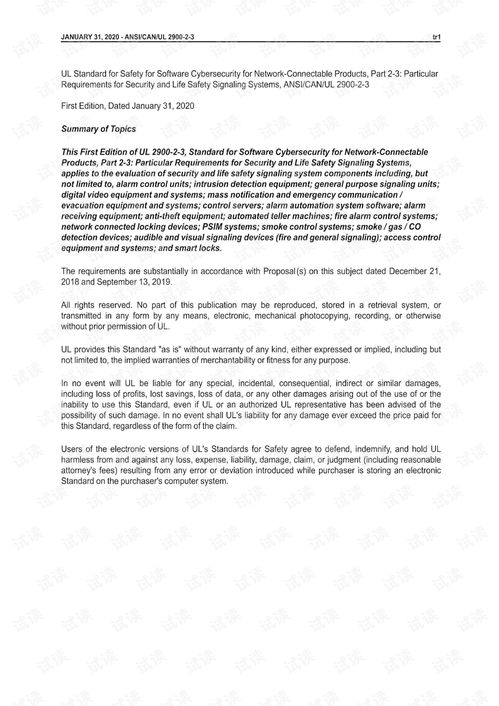
In an era where digital and physical infrastructures are increasingly intertwined, the cybersecurity of network-connectable products has become paramount, especially for systems where human safety and lives are at stake. The American National Standards Institute (ANSI) and Underwriters Laboratories (UL) have jointly addressed this critical need with the publication of ANSI/UL 2900-2-3:2020. This document, titled "Software Cybersecurity for Network-Connectable Products, Part 2-3: Particular Requirements for Security and Life Safety Signaling Systems," represents a specialized and vital extension of the broader UL 2900 series.
The Core Mission: Securing Critical Systems
The primary objective of ANSI/UL 2900-2-3 is to establish a set of verifiable cybersecurity requirements specifically tailored for security and life safety signaling systems. This category encompasses a wide range of critical products, including but not limited to:
- Fire alarm and detection systems
- Intrusion detection and burglar alarm systems
- Access control systems
- Emergency communication systems (e.g., mass notification)
- Carbon monoxide detection systems
These systems form the backbone of modern building and facility safety. A cybersecurity breach in such a system could lead to false alarms, system failure during an emergency, unauthorized access to secure areas, or manipulation of life-critical notifications, directly endangering lives and property. Therefore, moving beyond generic IT security, this standard provides a risk-based framework to evaluate the software and firmware vulnerabilities in these products.
Structure and Key Requirements
The 27-page document is a focused companion to the foundational ANSI/UL 2900-1 (the general requirements) and ANSI/UL 2900-2-1 (for industrial control systems). It applies the core principles of the UL 2900 series—such as risk assessment, secure development lifecycle, and vulnerability testing—within the specific context of safety signaling.
Key areas covered include:
- Risk Management: Mandating a structured risk assessment process to identify, evaluate, and mitigate cybersecurity risks specific to the safety system's intended use and environment.
- Software Development Security: Outlining requirements for secure coding practices, software architecture, and configuration management throughout the product's development lifecycle.
- Vulnerability and Malware Assessment: Defining methods for testing the product for known software vulnerabilities, weaknesses, and resistance to malware.
- Security Controls: Specifying requirements for access control, data protection (integrity and confidentiality of alarm signals and configurations), audit logging, and secure software updates.
- Reliability and Resilience: Ensuring that cybersecurity measures do not compromise the primary safety function of the system and that the system can maintain defined operational states under attack or stress.
Why is This Standard Significant?
For manufacturers, integrators, and specifiers in the security and life safety industry, ANSI/UL 2900-2-3 serves as a crucial benchmark.
- For Manufacturers: It provides a clear, standardized path to demonstrate due diligence in cybersecurity, potentially reducing liability and enhancing product marketability. Compliance can be a key differentiator, showing commitment to product integrity beyond mere physical functionality.
- For Specifiers and Building Owners: It offers a criterion for selecting products that have been independently verified for cybersecurity robustness, thereby integrating digital security into the overall safety posture of a facility.
- For the Industry at Large: It helps elevate the baseline cybersecurity maturity, making it harder for malicious actors to exploit these critical systems and fostering greater trust in connected safety technologies.
Access and the Role of Technical Communities
As noted in resources like the CSDN download community, this complete 27-page English version is a sought-after technical document among professionals in network and information security and security software development. Platforms like CSDN facilitate the dissemination of such critical standards, enabling developers, testers, and security researchers to access, study, and implement these guidelines. Engaging with these technical communities allows for deeper discussion, practical insights, and shared learning on applying the standard's requirements to real-world product development and assessment.
Conclusion
ANSI/UL 2900-2-3:2020 is more than just a technical specification; it is a proactive shield for our most vital protective systems. By translating broad cybersecurity principles into actionable requirements for security and life safety signaling products, it plays an indispensable role in safeguarding both digital infrastructure and human life. As the Internet of Things (IoT) continues to penetrate every aspect of the built environment, adherence to such specialized standards will be non-negotiable for ensuring a secure and resilient future.
如若轉(zhuǎn)載,請注明出處:http://www.shdianjinbaoo.cn/product/45.html
更新時間:2026-06-06 03:48:16